Jeannine Belléguic: The Quiet Breton Life Behind a Name That Went Searching
Search the name Jeannine Belléguic and the usual shape of a trending profile never appears: no career, no controversy, no reason the world should have come looking. What surfaces instead is something rarer and quietly more affecting. A woman who lived ninety-three years in one small corner of western France, raised a family, buried a husband decades before her own time came, and left behind a public footprint that fits on a single funeral notice. The internet turned that notice into a search term. The task here is to hold the two apart: the real person, and the noise that gathered around her name afterward.
Anyone arriving in hope of a secret life will leave a little disappointed and, likely, a little moved instead. The most honest thing that can be written about Jeannine Belléguic is that she was ordinary in the way that quietly holds a community together, and that most of what circulates online about her is either thin, borrowed from the wrong person, or invented to fill the silence. For that reason, only what the documents actually say has been kept.
At a Glance
| Full name | Jeannine Joséphine Annick Bleuzen |
| Married name | Madame Jean-Charles Belléguic, née Bleuzen |
| Born | 28 May 1931, Quimperlé, Finistère |
| Died | 18 April 2025, Lorient, Morbihan, aged 93 |
| Husband | Jean-Charles Belléguic (predeceased her) |
| Children | Gilles, Catherine, Pierre-Yves |
| Resting place | Cimetière Saint-David, Quimperlé |
| Nationality | French · Breton roots |
Who she actually was
Jeannine Belléguic was born Jeannine Bleuzen in Quimperlé, a river town where the Isole and Ellé meet to form the Laïta, on 28 May 1931. Her civil record carries three given names, Jeannine Joséphine Annick, the kind of layered naming that was common in Breton Catholic families of that generation. She married into the Belléguic family and, in the formal style of French notices, became known as Madame Jean-Charles Belléguic.
That marriage is the one place where the record brushes against anything resembling public life. Her husband, Jean-Charles Belléguic, is associated in family notices with a financial role at the Papeteries de Mauduit, a paper manufacturer with deep roots in the region. It matters to say this clearly, because several online write-ups quietly attach his working life to hers. The paper-industry connection belongs to him. Jeannine's own record shows no profession, no business, no title of her own. She was, by every available document, a woman whose life was organized around her household and her region rather than any career.
A life measured against its century
There is a particular weight to a life this long lived this close to home. Born in 1931, Jeannine was a small child when the Second World War reached Brittany, a young woman during the lean reconstruction years, and middle-aged through the social upheavals that reshaped French family life in the sixties and seventies. She would have watched Quimperlé modernize around her while she stayed put. The record does not narrate any of this. It only lets us place her inside it.
The one event the documents do mark, and it is a heavy one, is that she outlived her husband by a very long time. Family notices indicate her widowhood began decades before her own death, which means she carried the household forward and raised or finished raising her children largely on her own. That is not a dramatic fact in the way the internet likes its facts, but it is the truest measure of the woman: resilience spread thin across many ordinary years.
Her name did not survive because of what she achieved. It survived because a careful family notice was written, indexed, and then found by strangers who mistook stillness for mystery.
The documented record, step by step
Rather than smooth everything into prose, here is the verifiable sequence exactly as the death and funeral notices lay it out. Each entry is anchored to a stated date, which is the safest way to handle a record this sparse.
| 28 May 1931 | Jeannine Joséphine Annick Bleuzen is born in Quimperlé, Finistère. |
| 18 April 2025 | She dies in Lorient, Morbihan, at the age of 93. The passing is connected in notices with Quimperlé, Lorient, and Guidel. |
| 22 April 2025 | The family death notice appears publicly, naming her children and wider family. |
| 23 April 2025 | Visits begin at the Chambre Funéraire du Pays de Quimperlé, in the Salon Mer. |
| 25 April 2025 | A religious funeral is held at 2:30 p.m. in the Église Notre-Dame de Quimperlé, followed by burial at Cimetière Saint-David. |
The confusion worth clearing up
Two women, one spelling, a lot of mixed-up pages
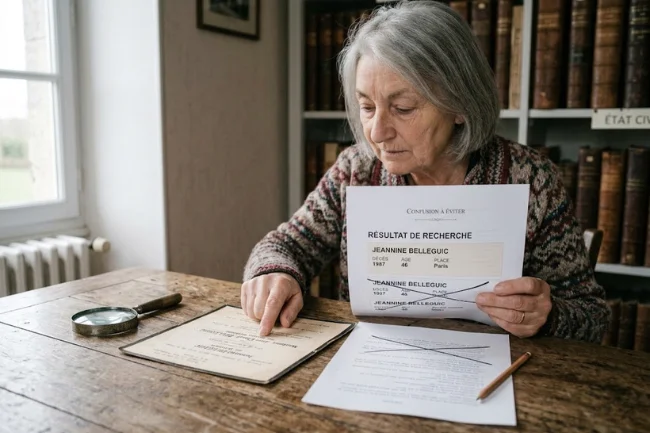
Here is the single most useful fact for anyone searching this name, and the reason so many online profiles contradict each other. There are at least two separate people recorded as Jeannine Belleguic, and the internet keeps blending them into one impossible biography. If one thing from this piece is worth keeping, it is this comparison.
| The 2025 Quimperlé record | A different, earlier record |
| Jeannine Belléguic, née Bleuzen. Born 28 May 1931, Quimperlé. Died 18 April 2025, aged 93, in Lorient. Married to Jean-Charles Belléguic. This is the woman this article is about. | A separate Madame Jeannine Belleguic. Died 12 June 1987, aged 46. Linked in indexing to the Bordeaux area, not Brittany. No connection to Quimperlé or Bleuzen. Should not be merged with the 2025 notice. |
Why this matters: when a page claims Jeannine Belléguic died at 46, or places her near Bordeaux, it has quietly swapped in the 1987 person. The 93-year-old Breton woman and the 46-year-old recorded elsewhere are not the same individual, and no reliable document ties their stories together.
What is solid, and what is only a guess
Because so much floating online about this name is padded or speculative, it helps to sort claims by how well they actually hold up. The table below is an honest grading of the common statements a reader will encounter.
| Claim | How well it holds up | Basis |
| Died 18 April 2025, aged 93 | Strong | Stated directly in the family death notice |
| Born Jeannine Bleuzen, 1931, Quimperlé | Strong | Birth name and birthplace in civil indexing and notices |
| Funeral at Notre-Dame de Quimperlé, 25 April 2025 | Strong | Named venue, date, and time in the notice |
| Married to Jean-Charles Belléguic | Strong | Spouse named in the notice |
| Three children: Gilles, Catherine, Pierre-Yves | Strong | Children listed in the family announcement |
| She personally worked in the paper industry | Weak | That role belongs to her husband, not to her |
| Any career, wealth, or public profile | Unsupported | Nothing in the record establishes it |
| Death at 46 near Bordeaux | Wrong person | Belongs to a different Jeannine Belleguic from 1987 |
Why a private name starts trending
It is worth understanding how someone who never sought attention ends up as a search query, because the answer is not sinister. French death notices are published through outlets such as Ouest-France and gathered into memorial databases. Those pages get indexed. A distinctive name attached to a clear set of dates becomes exactly the kind of tidy entry a search engine surfaces well. Once a few content sites notice the traffic, they produce their own versions, and the loop feeds itself.
The trouble is that there is almost nothing to write, so the weaker sites stretch. They borrow the husband's job, fold in the unrelated 1987 record, or dress up plain facts in invented emotion. The result is a cluster of pages that sound informative while adding nothing true. Read several back to back and the pattern becomes obvious: the same handful of real facts, reshuffled and inflated. That is the gap this article refuses to widen.
A closing thought
Sit with the few documents that survive her and what remains is not a mystery solved but a proportion restored. Jeannine Belléguic was not hiding anything. There was simply never much to find, because she lived the kind of life that does not generate records, only relationships. Ninety-three years, one region, one family, a long widowhood carried without fuss. The search traffic around her name is a modern accident. The life underneath it is a quietly complete thing.
If this page does one useful job, let it be this: it keeps her separate from the wrong records, refuses to invent a biography she never had, and lets her remain what she was. A Breton woman who stayed close to home, loved her people, and was seen off with a service in a church she likely knew all her life. That is not a thin story. It is a full one, told in few words, and it deserves to be repeated accurately rather than embroidered.