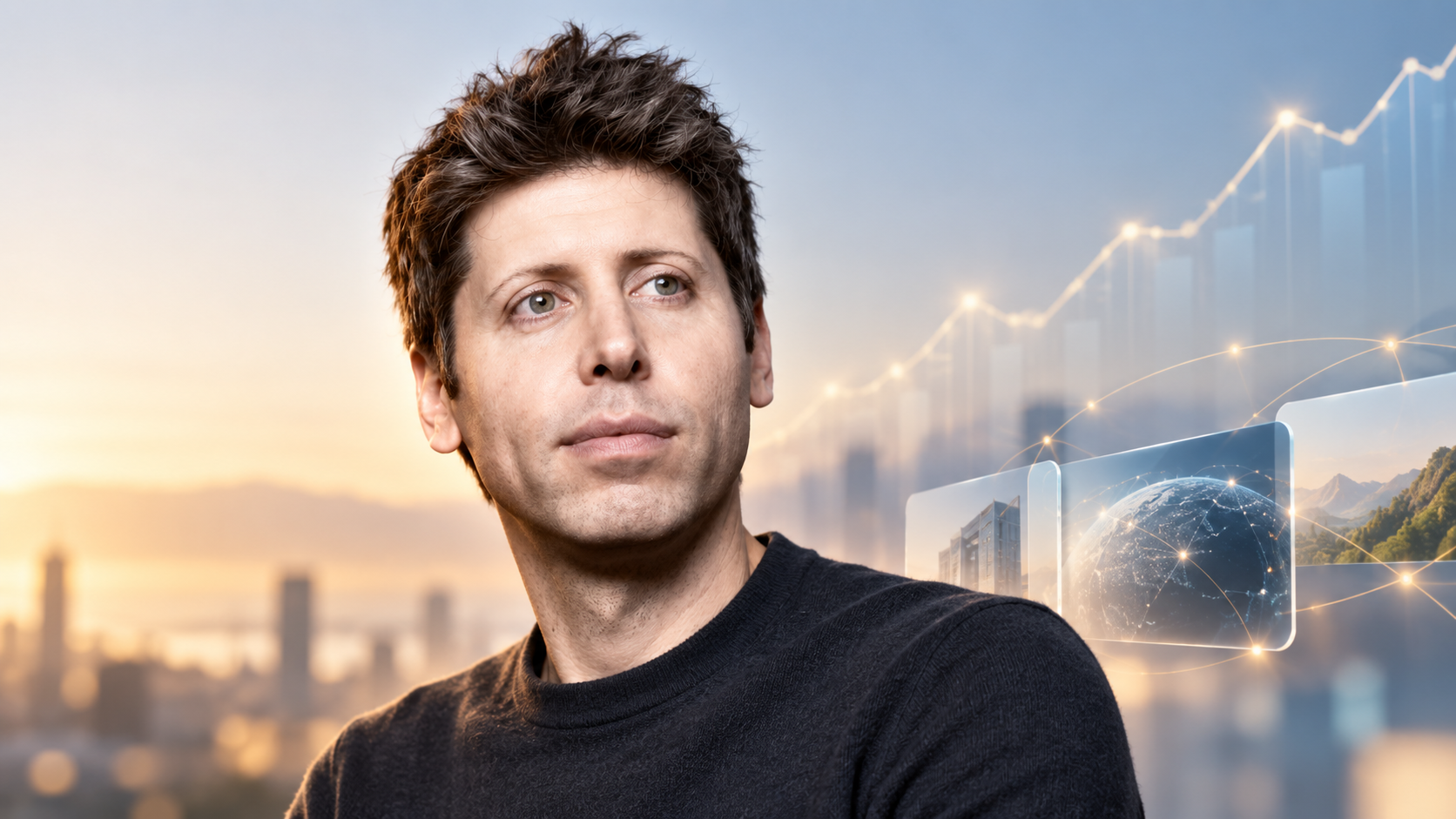
I have kept ChatGPT open in a browser tab almost every working day for the last two years. It drafts my outlines, argues with me about headlines, and quietly reshaped how I do my job. So when I first read that the man running the company behind it takes home a salary of roughly seventy-six thousand dollars and owns none of it, I assumed it was a typo. It is not. I went back through the Musk trial exhibits, the Forbes tracker, and OpenAI's own restructuring disclosures, and the picture only got stranger the longer I sat with it.
The short version: Sam Altman is a billionaire many times over, and almost none of that wealth has anything to do with OpenAI. What follows is a plain, sourced breakdown of the number, where it comes from, and the one boardroom decision that could rewrite it overnight.
The bottom line
$4B+ 2026 net worth (Forbes) | $76,001 OpenAI CEO base salary |
0 Direct OpenAI shares | $1.65B Stake in Helion Energy |
Around $4 billion, and it keeps being recalculated
There is no single confirmed number here, and anyone who gives you one to the dollar is guessing. The honest starting point is a range.
Forbes put Altman near $3.3 billion in April 2026, based on his known venture portfolio. Weeks later it revised the figure to more than $4 billion, after courtroom testimony forced several private stakes into the open for the first time. Celebrity aggregators run higher, into the $5 billion to $6.5 billion territory, but no audited filing backs those numbers. The reason for the spread is simple: nearly everything he owns is private, illiquid, and revalued by outsiders rather than priced by a market.
| Source | Estimate | As of | Based on |
|---|---|---|---|
| Forbes | $1.2B | Early 2025 | Pre-trial venture portfolio |
| Forbes | $3.3B | April 2026 | Known venture holdings |
| Forbes (revised) | $4B+ | May 2026 | Trial disclosures added |
| Aggregators | $5B to $6.5B | 2026 | Higher private valuations, unaudited |
For the rest of this piece I use the Forbes figure of a little over $4 billion as the working number, because it is the most defensible one on the record. Just remember it is an estimate stacked on other estimates.
Who Sam Altman actually is
Before OpenAI, before Y Combinator, there was a kid in Missouri with an Apple Macintosh and an unusual amount of nerve.
| Detail | Fact |
|---|---|
| Born | 22 April 1985, Chicago. Raised in St. Louis, oldest of four. |
| First computer | An Apple Macintosh, at age eight. |
| Education | Stanford University, dropped out after two years. |
| First company | Loopt, sold to Green Dot for $43.4 million in 2012. |
| Y Combinator | Joined 2011, president from 2014 to 2019. |
| Own fund | Hydrazine Capital, seeded with the Loopt proceeds. |
| OpenAI | Co-founded in 2015, CEO since 2019. |
| Personal | Married Oliver Mulherin in Hawaii in 2024. First child via surrogacy in early 2025. |
The Loopt exit is the seed of everything that follows. Altman did not spend the $43 million; he turned it into a fund and used his front-row seat at Y Combinator, where he screened thousands of startups a year, to place early bets on companies most people had never heard of. That habit, not any single company, is the real engine of his fortune.
Where the money comes from
The Wall Street Journal reported he has backed more than 400 companies. A handful of them carry almost all the weight.
Most of what we can verify with precision comes from a single event: the 2026 Musk v. OpenAI trial, where a confidential list of Altman's stakes in nine private companies entered the record with fair-market values dated 31 December 2025. Here are the ones we can name.
| Company | Sector | Stake | Reported value |
|---|---|---|---|
| Helion Energy | Nuclear fusion | About one third | $1.65B |
| Stripe | Payments | Early stake, bought 2009 | ~$633M |
| Retro Biosciences | Longevity research | Backer | ~$258M |
| Social platform | 8.7% at 2024 IPO | Public stake | |
| Oklo | Nuclear fission | Early investor | Undisclosed |
| Cerebras | AI chips | Investor | Undisclosed |
| Airbnb | Travel | Early investor | Undisclosed |
Two details are worth pausing on. His Stripe position dates to 2009, when he reportedly paid about $15,000 for roughly 2 percent of a company now worth tens of billions. And his Reddit holding was made public in that platform's 2024 IPO filing, which disclosed he held 8.7 percent. These are not lucky lottery tickets. They are the compounded result of being early, repeatedly, for over a decade.
Altman got rich the way a good investor does, not the way a founder does: by being right about other people's companies, with his own money, again and again.
The zero-equity paradox
He leads one of the most valuable private companies on earth and cannot cash a single share of it.
$76,001 Altman's annual OpenAI salary | ~$730B+ OpenAI's 2026 valuation |
OpenAI was valued at roughly $730 billion in a February 2026 round, and Bloomberg's April reporting put the figure closer to $825 to $852 billion. Altman owns no equity in any of it. His salary of $76,001 is up modestly from $73,546 the year before, and earlier filings cited a figure nearer $65,000. OpenAI has said any tiny indirect exposure he once had, through a Y Combinator fund, was insignificant and has already been sold.
The contrast with his own colleagues makes it sharper. Forbes has reported OpenAI president Greg Brockman's stake at close to $30 billion, and co-founder Ilya Sutskever's at around $7 billion. The person most associated with the company, the one testifying before Congress and negotiating with Microsoft, is not on that list. He built the thing and captured almost none of its balance-sheet value.
The trial that opened the books
For years, Altman's finances were a matter of estimate. A federal courtroom in Oakland changed that.
In the spring of 2026, Elon Musk's lawsuit against OpenAI and Altman went to trial, alleging the company had abandoned its nonprofit mission and that Altman had personal conflicts of interest. Musk's lawyer, Steven Molo, walked Altman through nine companies in which he holds personal stakes that also do business with OpenAI, among them Helion, Stripe, Reddit and Cerebras.
Under questioning, Altman confirmed those positions totaled more than $2 billion, with the Helion stake, first made around 2015, the largest by far. He testified that each of those deals went through board-level recusal. Whatever you make of the ethics argument, the trial did something no press release ever had: it put real numbers on the record. That is why Forbes revised his net worth upward in May 2026.
Houses and land
Altman spent an estimated $85 million on property between 2020 and 2022, a portfolio valued near $100 million. Substantial by any normal measure, and tiny next to the company he runs.
| Property | Detail | Status |
|---|---|---|
| $27M, San Francisco | Russian Hill home bought March 2020, with a wellness building and infinity pool. | Still held |
| $15.7M, Napa Valley | 950-acre estate acquired December 2020, two private lakes, five residences. | Later sold |
| Hawaii | A mega-estate on the islands put on the market in early 2026. | On sale |
To put the scale in perspective, the $27 million San Francisco house is worth under 1 percent of his personal fortune, and a rounding error against OpenAI's valuation. The man lives well, but he is not spending like someone who owns a trillion-dollar company. He is spending like an investor who did well on some early bets.
OpenAI's structure, and the IPO that could change everything
The reason Altman has no shares is baked into how the company is built. That structure is now shifting.
OpenAI restructured its for-profit arm into OpenAI Group PBC, a public benefit corporation controlled by the renamed nonprofit OpenAI Foundation. The Foundation holds roughly 26 percent, a stake worth around $130 billion. Microsoft holds about 27 percent, and employees and investors hold roughly 47 percent between them. Altman took no equity in the new entity.
| Holder | Share | Note |
|---|---|---|
| Employees and investors | ~47% | Includes SoftBank-led capital |
| Microsoft | ~27% | Long-time partner |
| OpenAI Foundation (nonprofit) | ~26% | Worth roughly $130B |
| Sam Altman | 0% | No direct stake |
In June 2026, OpenAI filed a confidential draft registration with the SEC, the first formal step toward a public listing that bankers have discussed in the $850 billion to $1 trillion range. Here is the pivot point for Altman's entire financial story: if the board ever grants its CEO a conventional stake, even a small percentage of a company that size would dwarf everything he owns today. If it does not, he will retire as the architect of the defining technology of the decade with roughly none of its equity. That single decision is the biggest variable hanging over any number in this article.
What is verified, and what is guesswork
Net worth articles love to blur these two categories. Keeping them apart is the whole point.
On the record ● Forbes estimate above $4 billion, May 2026. ● Zero direct OpenAI equity, stated under oath. ● Base salary of $76,001. ● About one third of Helion, valued at $1.65 billion in court filings. ● 8.7 percent of Reddit, per its 2024 IPO filing. | Still estimated ● The $5 billion to $6.5 billion aggregator figures, with no audited filing behind them. ● His exact total portfolio value, since most of it is private and illiquid. ● Present-day values of undisclosed stakes like Oklo and Cerebras. ● Whether he ever receives OpenAI equity. |
The final verdict
After two years of leaning on ChatGPT every day and then a long afternoon buried in trial exhibits and filings, here is where I land. Sam Altman's fortune is one of the very few in technology you can call self-made in the most literal sense of the phrase. His roughly $4 billion is a scorecard of decisions he made with his own capital, at real risk, mostly before OpenAI meant anything to anyone. He did not found Helion. He did not build Stripe. He wrote checks and was right.
Whether that story holds is now down to a single boardroom. Grant him equity before an IPO and this entire article ages in an afternoon. Leave the structure as it is and he becomes the rare CEO who built something world-changing and pocketed almost none of its market value. Both outcomes are on the table right now.
For the moment, the strangest sentence in tech stays true. The person who did more than almost anyone to put artificial intelligence in front of the world captured close to zero of its money. Every time I open that browser tab, I think about that, and I still cannot quite decide whether it is admirable or absurd. Probably both.