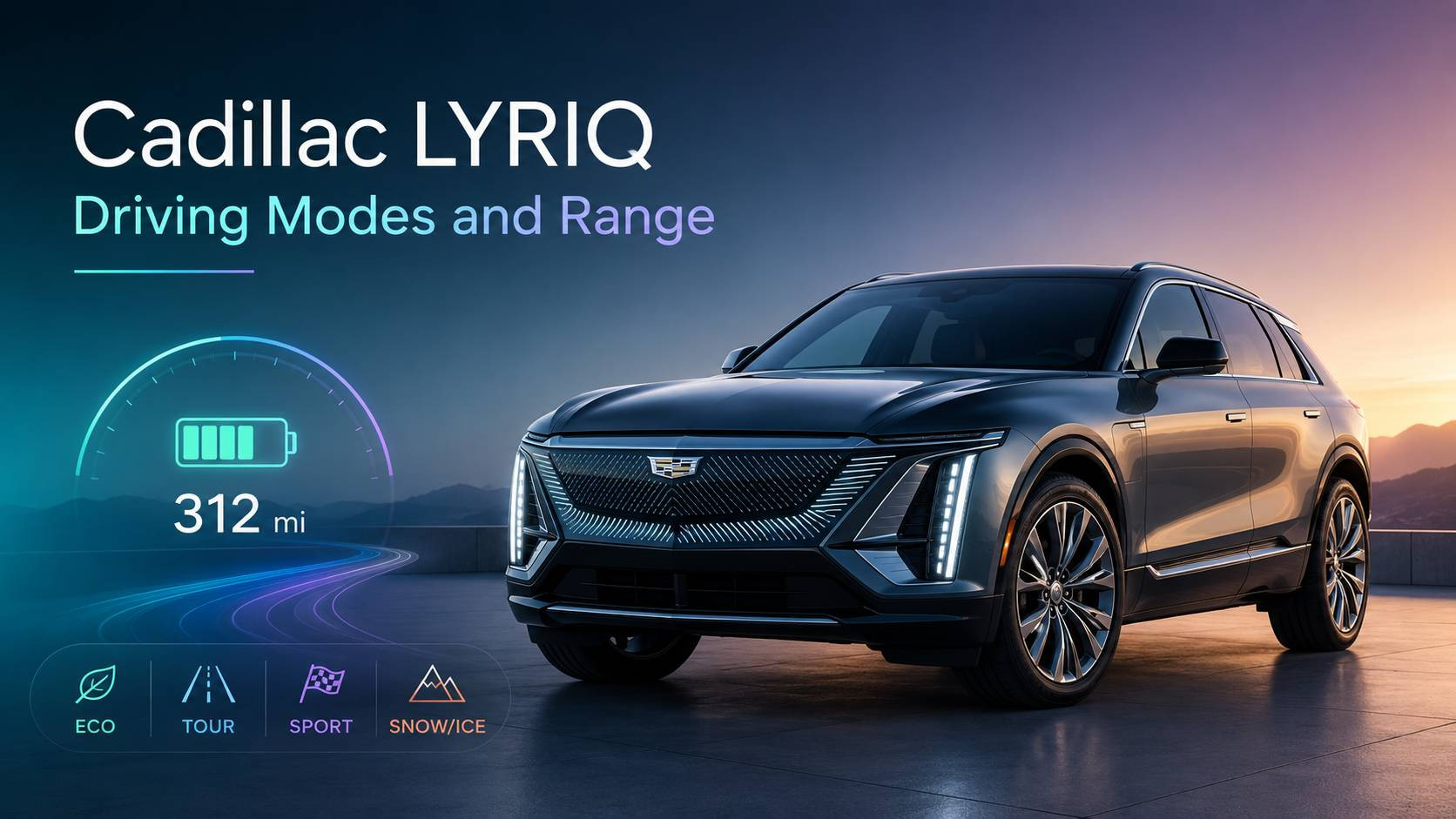
Do the Driving Modes in the Cadillac LYRIQ Offer Different Ranges or Battery Usage?
The Cadillac LYRIQ does not give drivers separate official range numbers for Tour, Sport, Snow/Ice, or My Mode. But that does not mean the modes are irrelevant to battery use. In an electric SUV, small changes in throttle response, torque delivery, regen behavior, traction control, speed, and driver input can change how quickly the battery drains in real driving.
The simple answer is this: the LYRIQ’s drive modes do not change the battery size, but they can change how efficiently the vehicle uses that battery. The difference is not always dramatic on the display, but it can become noticeable over a long highway run, in cold weather, in stop-and-go traffic, or when Sport mode encourages heavier acceleration.
The Short Answer First
The Cadillac LYRIQ uses a large 102 kWh battery platform across its main lineup. The official range depends more on drivetrain, wheel setup, trim, and performance configuration than on the selected drive mode. A rear-wheel-drive LYRIQ is rated higher than most all-wheel-drive versions because it uses fewer driven motors under normal operation and carries a different efficiency profile.
Drive modes work in a different way. They change how the LYRIQ responds to the driver and road conditions. Tour mode is smoother and better suited for everyday efficiency. Sport mode sharpens response and can make the vehicle consume more energy if the driver uses the extra performance. Snow/Ice mode slows acceleration and torque response for grip, not range. My Mode depends on what the driver customizes.
Key point: the mode itself is not a fixed “range setting.” The way the mode changes driving behavior is what affects battery usage.
What Cadillac Officially Says About LYRIQ Range and Drive Modes
Cadillac does not list a separate official range number for every LYRIQ drive mode. Instead, the official range is tied to the vehicle configuration, battery, drivetrain, wheels, and model version.
For example, the 2026 Cadillac LYRIQ uses a 102 kWh rated battery pack, and Cadillac lists up to 326 miles of EPA-estimated range for rear-wheel-drive models. That range number is not presented as “Tour mode range” or “Sport mode range.” It is the vehicle’s official estimated range under standard testing conditions.
Cadillac describes Snow/Ice mode as a setting intended to help prevent wheel spin in snow or slippery conditions. Sport mode is described as being calibrated for a stronger feeling of road connection. That means the modes are mainly about driving behavior, traction, and response — not separate battery sizes or fixed range ratings.
Cadillac LYRIQ Range and Battery Baseline
Before looking at drive modes, it helps to set the baseline. The LYRIQ’s battery and range figures give a clearer idea of how energy usage works.
| LYRIQ Version | Battery Capacity | Official Range Estimate | Approx. Energy Use Based on Full Pack |
| LYRIQ RWD | 102 kWh | Up to about 326 miles | About 31.3 kWh/100 miles |
| LYRIQ AWD | 102 kWh | Around 303 to 319 miles | About 32.0 to 33.7 kWh/100 miles |
| LYRIQ-V | 102 kWh | Around 285 miles | About 35.8 kWh/100 miles |
These figures show something important. The same battery can deliver different range depending on motor setup, performance tuning, weight, rolling resistance, and how much power the vehicle is prepared to deliver. That is the same logic behind drive modes, only on a smaller and more driver-dependent scale.
Simple Range Comparison Chart
Estimated Full-Charge Range
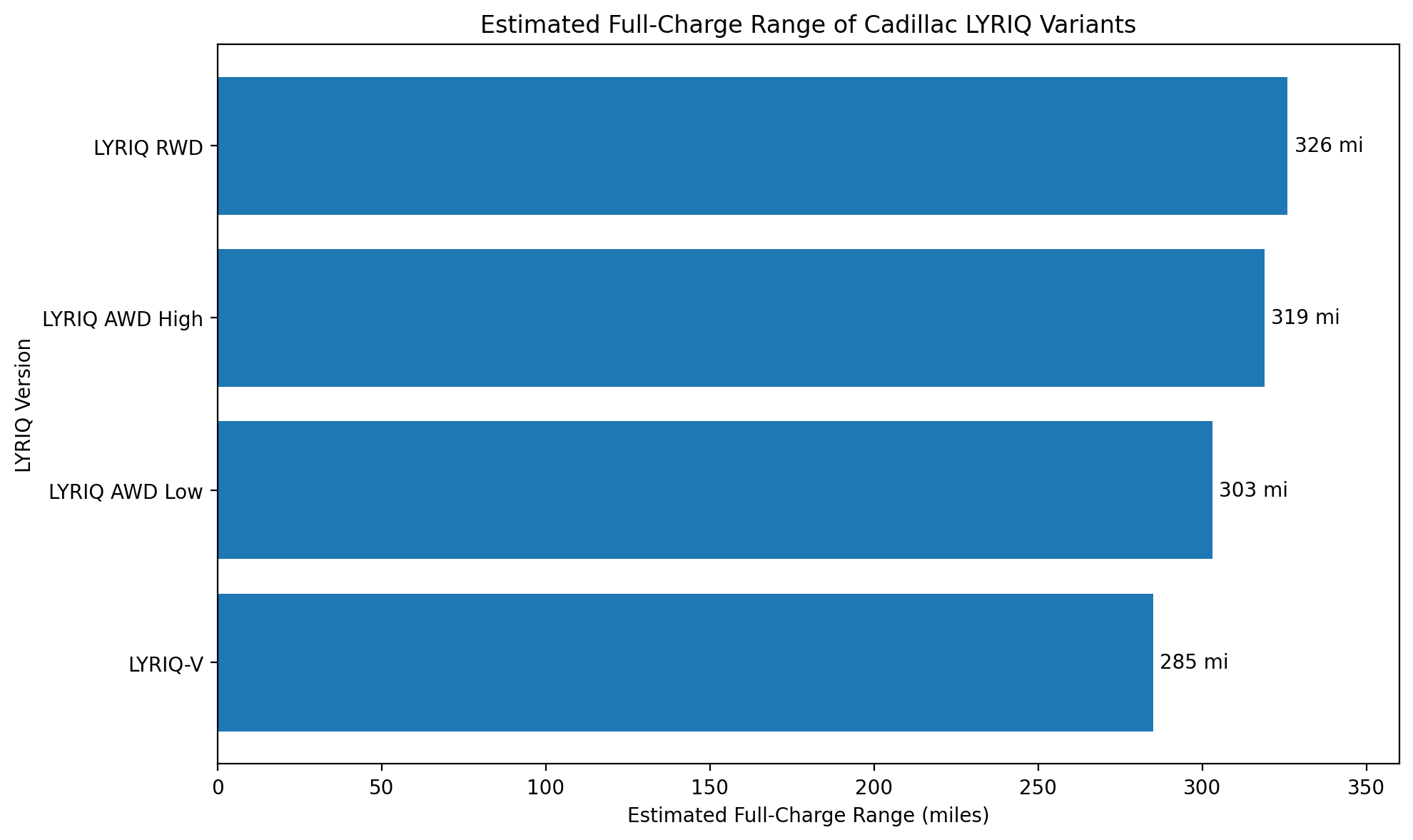
This chart is not a drive-mode chart. It shows the bigger range pattern: hardware and tuning matter more than the selected mode. Drive mode then sits on top of that baseline and influences how much of that efficiency the driver actually keeps.
Best Mode by Situation
| Situation | Best LYRIQ Mode | Why |
|---|---|---|
| Daily driving | Tour | Smoothest and most predictable |
| Long highway trip | Tour | Helps maintain steady energy use |
| Low battery | Tour | Avoids aggressive response |
| Rain, snow, or ice | Snow/Ice | Helps reduce wheel spin |
| Quick passing | Sport | Gives sharper response |
| Custom feel | My Mode | Depends on settings |
| Performance driving | V Mode / Sport | Prioritizes power over range |
What Each LYRIQ Drive Mode Really Changes
The LYRIQ’s drive modes are best understood as behavior profiles. They do not magically add or remove battery capacity. They change how the SUV feels, reacts, and manages traction.
| Drive Mode | What It Prioritizes | Likely Battery Impact | Best Use Case |
| Tour | Smooth everyday driving | Usually the most efficient option | Daily commuting, mixed driving, long-distance cruising |
| Sport | Quicker response and sharper feel | Can increase energy use | Spirited driving, quicker passing, more responsive feel |
| Snow/Ice | Slower torque response and wheel-slip control | Not designed for efficiency | Slippery roads, snow, ice, low-grip surfaces |
| My Mode | Custom driver setup | Depends on selected settings | Drivers who want a personalized balance |
| V Mode / Velocity-focused settings | Maximum performance | Higher energy draw | Performance driving, short bursts, acceleration-focused use |
Tour mode is the closest thing to the LYRIQ’s calm efficiency setting. It keeps the SUV smooth and predictable, which makes it easier to avoid sudden energy spikes. In an EV, hard acceleration is one of the fastest ways to reduce efficiency because the motor draws more power in a short period.
Sport mode does not necessarily destroy range by itself. If a driver selects Sport but drives gently, the difference may be modest. The real issue is that Sport mode makes quick acceleration more tempting and more immediate. That behavior can lower miles per kWh, especially in city traffic where repeated launches matter.
Snow/Ice mode is often misunderstood. It may feel calmer because it softens acceleration, but it is not primarily an efficiency mode. Its job is to reduce wheel slip and improve control on low-grip roads. In cold weather, range may already be lower because the battery and cabin need heat. So even if Snow/Ice mode smooths torque delivery, winter conditions can still increase battery use.
The Real Battery Drain Is Usually Driver Behavior, Not the Label on the Screen
Drive modes matter, but the LYRIQ’s battery usage is shaped more heavily by what the driver does after choosing the mode.
A driver in Tour mode who accelerates hard, cruises at high highway speeds, uses maximum cabin heat, and runs 22-inch wheels may use more energy than a careful driver in Sport mode. The mode creates a tendency, not a guaranteed result.
Important battery-use triggers include:
● Fast acceleration from a stop.
● High cruising speeds above typical efficiency zones.
● Cold-weather battery and cabin heating.
● Heavy use of climate control.
● Larger wheels and higher rolling resistance.
● Frequent elevation changes.
● Towing or carrying heavy cargo.
● Low tire pressure.
● Repeated use of maximum-performance settings.
This is why some LYRIQ owners may see different results from the same mode. One driver may use Sport only for steering feel and still drive smoothly. Another may use Sport as a launch mode at every traffic light. The second driver will see a much bigger drop in efficiency.
Tour Mode: The Safest Choice for Maximum Range
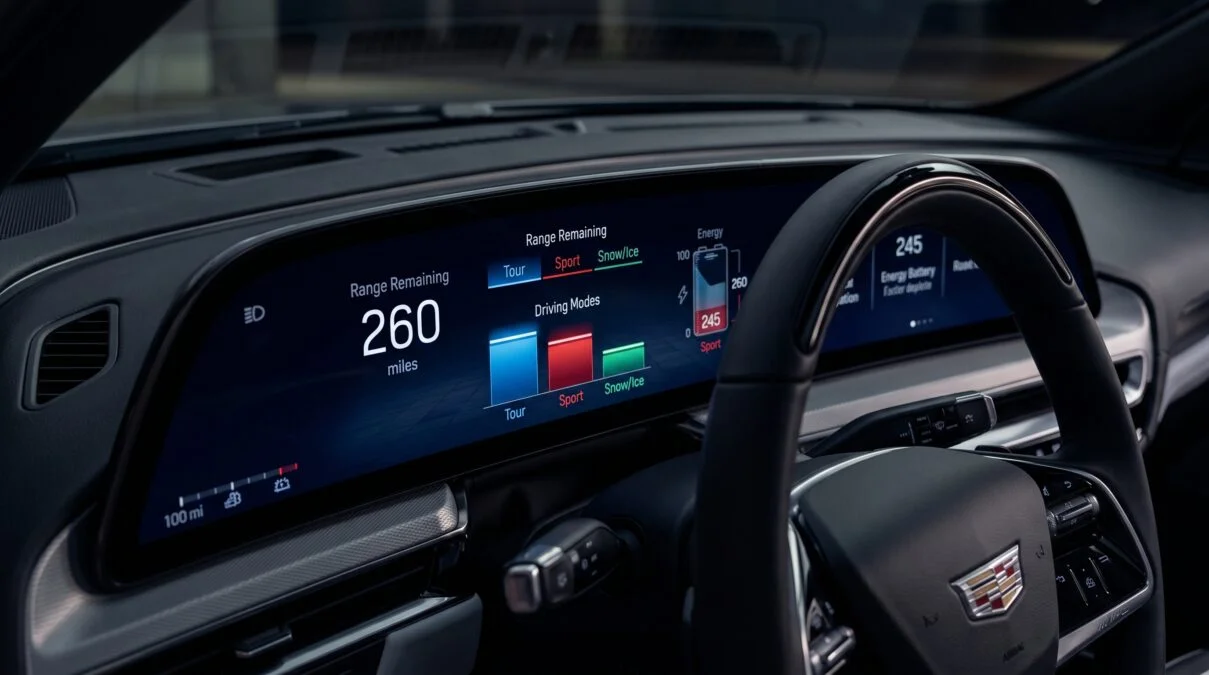
Tour mode is the best default for drivers who want the most predictable battery usage. It keeps the LYRIQ’s response more relaxed, which helps the driver maintain smoother acceleration and fewer energy spikes.
The biggest benefit of Tour mode is not that it unlocks a hidden battery-saving program. Its value is behavioral. The accelerator is easier to modulate, the vehicle feels less eager to surge forward, and the driver is more likely to keep speed changes gradual.
For long-distance driving, Tour mode is usually the cleanest choice because range depends heavily on consistency. A steady speed, gentle acceleration, and controlled climate settings will do more for battery life than constantly switching modes.
Tour Mode Efficiency Profile
| Area | Effect |
| Acceleration | Smoother and less aggressive |
| Range behavior | Most predictable |
| Driver temptation | Lower |
| Best environment | City, suburbs, highway cruising |
| Weakness | Less exciting response than Sport |
Tour mode should be treated as the LYRIQ’s practical baseline. If the goal is to arrive with more remaining charge, this is the mode most drivers should start with.
Sport Mode: Better Response, Higher Risk of Battery Drain
Sport mode changes the character of the LYRIQ. The vehicle feels more alert, accelerator response becomes sharper, and the SUV is more willing to deliver torque quickly. That makes the car feel more engaging, but it also creates a higher chance of inefficient driving.
In an EV, instant torque is enjoyable but energy-intensive when used repeatedly. Sport mode can make short bursts of acceleration feel effortless, and that is exactly where the battery usage can climb. The LYRIQ is a heavy luxury EV, so moving that mass aggressively takes energy.
Sport mode is not bad. It is simply less range-focused. It makes more sense for short drives, winding roads, quick passing, or drivers who value response over maximum efficiency. For highway range runs or cold-weather road trips, it is usually not the smartest default.
Sport Mode Battery Impact Chart
Battery Usage Risk by Mode
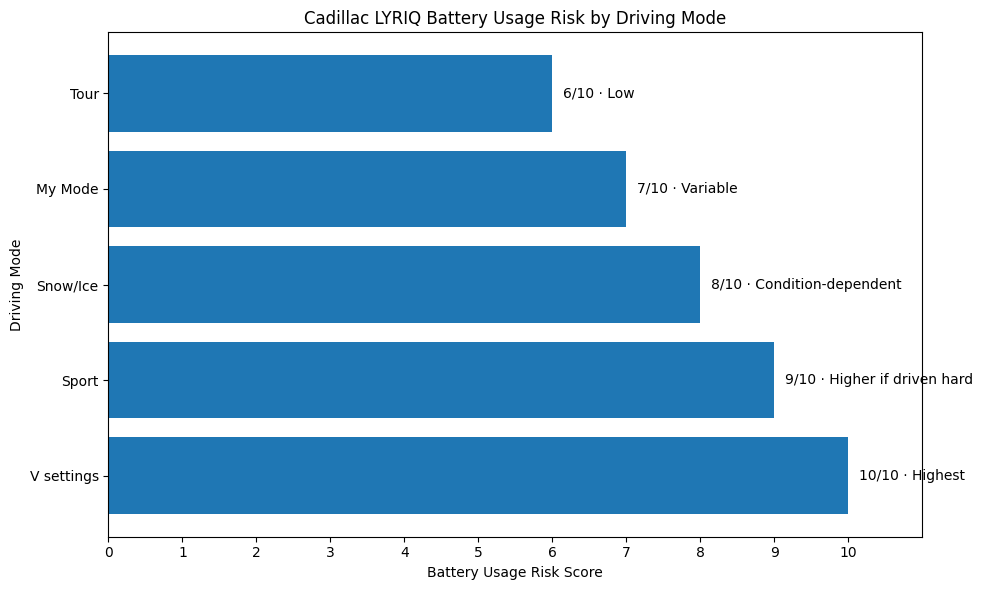
This chart reflects likely real-world behavior, not an official range rating. Sport mode becomes inefficient mainly when the driver uses the extra responsiveness often.
Snow/Ice Mode: Good for Control, Not a Range Hack
Snow/Ice mode can feel like it should save battery because it slows acceleration and torque response. That part is true in a narrow sense: softer torque delivery may reduce sudden energy spikes. But the mode exists for traction, not efficiency.
The problem is that Snow/Ice mode is normally used in conditions that are already bad for EV range. Cold air is denser, tires face more resistance, roads may be wet or snowy, and the battery may need temperature management. Cabin heating can also consume meaningful energy. These factors can outweigh any efficiency benefit from softer pedal response.
Snow/Ice mode should be used when the road requires it. It should not be used as a general range-extending mode on dry roads unless the driver specifically prefers the softer response. Its real value is stability, not battery preservation.
My Mode: The Most Misunderstood Setting
My Mode can be useful, but it is not automatically efficient. It depends on how the driver configures the vehicle. A driver can create a calm setup that feels close to Tour mode, or a sharper setup that behaves more like Sport.
This is where the LYRIQ becomes more personal. Some drivers may want lighter steering with gentle accelerator behavior. Others may want sharper steering and stronger response without using full Sport mode. The battery result will depend on the final mix.
The best way to use My Mode for range is to keep the accelerator behavior smooth and avoid performance-heavy settings. If the setup encourages relaxed driving, it can be efficient. If it encourages aggressive driving, it can drain more battery.
Regenerative Braking Matters More Than Most Drive Modes
The LYRIQ’s One-Pedal Driving and Regen On Demand features are more directly connected to energy recovery than the drive modes themselves. Regenerative braking allows the vehicle to convert some motion back into battery energy while slowing down. It cannot recover everything, but it can reduce wasted energy in stop-and-go driving.
One-Pedal Driving changes how the vehicle slows when the driver lifts off the accelerator. Regen On Demand gives the driver a paddle-based way to increase deceleration and recover energy. These features are especially useful in city driving, traffic, downhill sections, and situations where the driver can slow early instead of braking late.
However, regen is not magic. It is most useful when the driver plans ahead. Hard acceleration followed by hard regen is still less efficient than smooth acceleration and steady speed. The cleanest EV driving style is not “accelerate hard and recover later.” It is “avoid wasting energy in the first place.”
Drive Mode vs Regen: Which Affects Range More?
| Factor | Direct Effect on Range | Why It Matters |
| Drive mode | Medium | Changes response and driving behavior |
| Regen setting | Medium to high in city driving | Recovers some energy while slowing |
| Highway speed | Very high | Aerodynamic drag rises quickly |
| Climate use | High in extreme weather | Heating and cooling draw battery power |
| Wheel/tire setup | Medium | Rolling resistance affects every mile |
| Driver acceleration style | Very high | Repeated torque demand drains energy quickly |
This is why a LYRIQ in Tour mode with poor driving habits can underperform, while a LYRIQ in a custom setup with smooth driving can do better.
City Driving vs Highway Driving: Modes Behave Differently
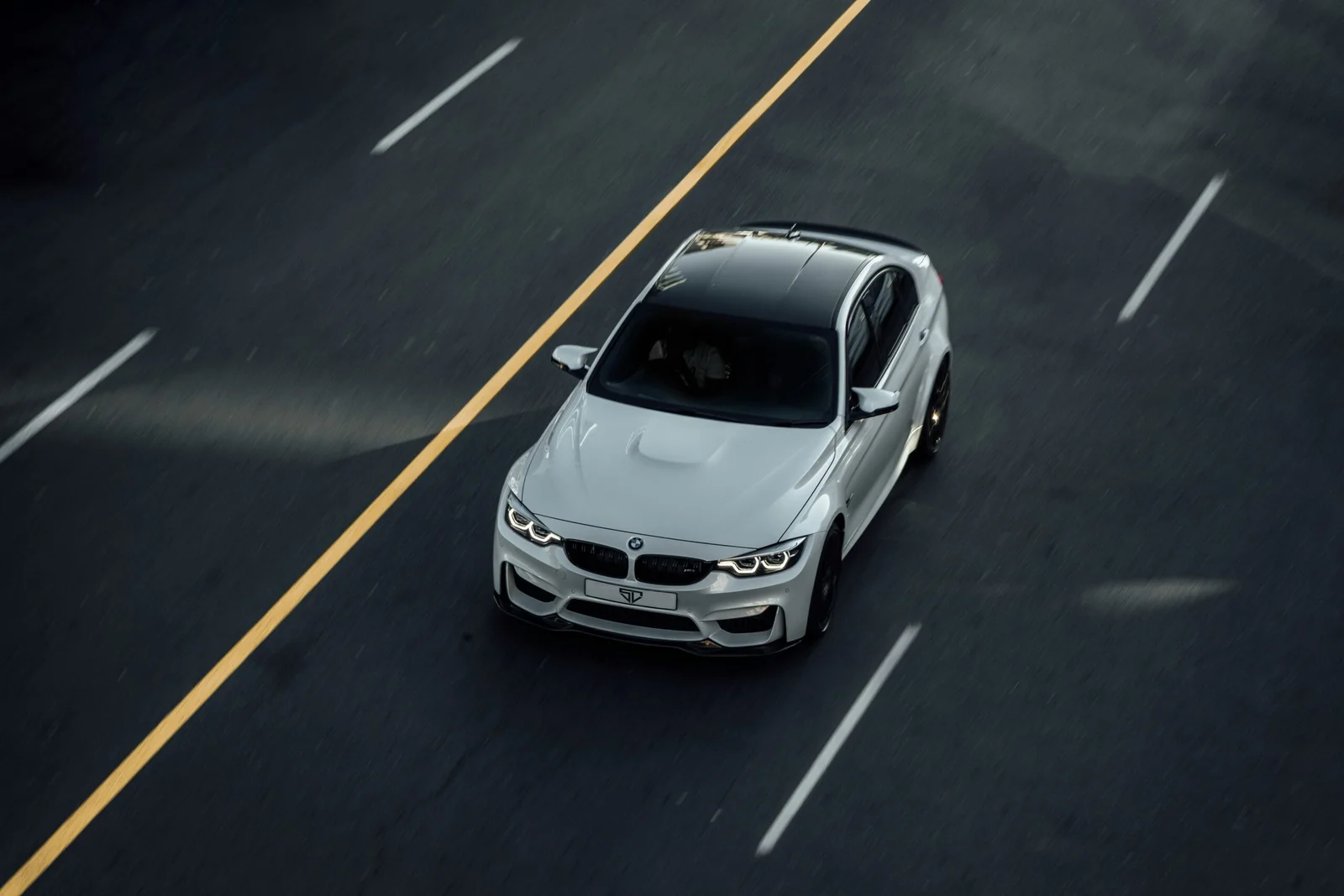
Drive modes have different effects depending on where the LYRIQ is driven.
In city driving, acceleration and braking happen constantly. That makes pedal mapping, regen, and driver smoothness very important. Tour mode plus One-Pedal Driving can work well because the vehicle is easier to control smoothly and can recover some energy during deceleration.
On the highway, drive mode matters less than speed. Once the LYRIQ is cruising steadily, aerodynamic drag becomes a major energy factor. Sport mode may not hurt much if the driver holds a steady speed, but high-speed cruising will reduce range no matter which mode is selected.
In winter driving, Snow/Ice mode may improve control, but range loss may still come from battery heating, cabin heat, cold tires, and road resistance. In performance driving, Sport or V-focused settings can reduce range quickly because the vehicle repeatedly draws high power.
Why the Range Display May Change After Switching Modes
Some drivers expect the LYRIQ’s range estimate to immediately change when they select a different drive mode. That may not always happen in a dramatic way. EV range displays usually depend on recent driving behavior, battery state of charge, climate use, temperature, terrain, and energy consumption history.
The vehicle may not treat Sport mode as a fixed range penalty. Instead, it watches how energy is actually being used. If the driver switches to Sport and drives gently, the range estimate may not fall sharply. If the driver starts accelerating aggressively, the estimate can drop faster over time.
This makes the display more realistic but also more confusing. The car is not only asking, “Which mode are you in?” It is also asking, “How are you driving right now?”
The 80 Percent Charging Rule and Regen Space
For daily use, many EV systems recommend charging to around 80 percent rather than always charging to 100 percent. One practical reason is battery health. Another is regenerative braking. A battery that is completely full has less room to accept recovered energy, so regen may be limited after a full charge.
This matters for LYRIQ drivers who rely on One-Pedal Driving. If the battery is near full, the vehicle may not provide the same regen feel or energy recovery as it would at a lower state of charge. That does not mean something is wrong. It means the battery has limited space to accept extra energy.
For daily driving, charging to around 80 percent and using regen smoothly can be more practical than charging to 100 percent every night. For road trips, charging above 80 percent can make sense when the extra range is needed.
Practical Range Strategy for LYRIQ Drivers
The best range setup is not complicated. It is a mix of the right mode, smooth inputs, and realistic expectations.
For maximum everyday efficiency:
● Use Tour mode for most normal driving.
● Turn on One-Pedal Driving if it feels natural.
● Use Regen On Demand when slowing early is possible.
● Keep highway speeds moderate.
● Avoid repeated hard launches.
● Precondition the cabin while plugged in when possible.
● Keep tires properly inflated.
● Avoid using Snow/Ice mode unless road conditions require it.
● Save Sport or performance settings for shorter drives or specific situations.
This approach will not turn the LYRIQ into a small economy EV. It is still a large luxury SUV with a big battery, substantial weight, and strong performance. But it can help the driver stay closer to the vehicle’s expected range.
What Buyers Should Know Before Blaming the Drive Mode
If a LYRIQ is using more battery than expected, the drive mode is only one possible reason. The more likely causes are speed, weather, climate load, tires, road conditions, and driving style.
A useful way to diagnose battery usage is to ask:
| Question | Why It Matters |
| Am I driving mostly above 70 mph? | Highway speed can reduce range quickly |
| Am I using strong heat or cooling? | Climate systems draw battery power |
| Am I accelerating hard often? | Instant torque uses significant energy |
| Is the weather cold, wet, or windy? | Conditions increase energy demand |
| Am I using larger wheels? | Larger wheels often reduce efficiency |
| Is my tire pressure low? | Rolling resistance increases |
| Am I towing or carrying heavy cargo? | Extra load increases consumption |
This is the more honest way to understand LYRIQ range. Drive modes influence the result, but they are rarely the only reason a driver sees lower efficiency.
Common Mistakes That Make LYRIQ Battery Usage Worse
Many LYRIQ owners blame the drive mode first, but the real problem is often the way the vehicle is being used. These mistakes can reduce range more than the mode itself:
- Driving fast on highways for long periods
- Using Sport mode and accelerating hard repeatedly
- Running strong cabin heat in cold weather
- Driving with low tire pressure
- Carrying unnecessary weight
- Using large wheels with higher rolling resistance
- Ignoring wind, rain, snow, and road conditions
- Charging to 100 percent and expecting full regen immediately
- Treating regenerative braking like a replacement for smooth driving
The best range usually comes from a simple setup: Tour mode, steady speed, smooth acceleration, smart regen use, and careful climate control.
Final Verdict
The Cadillac LYRIQ’s drive modes do not offer separate official range ratings. There is no simple menu where Tour gives one fixed number, Sport gives another, and Snow/Ice gives a third. The battery capacity remains the same, and the official range is mainly tied to drivetrain, trim, wheel setup, and performance tuning.
But in real driving, the modes can absolutely affect battery usage. Tour mode is the safest choice for range because it encourages smoother driving. Sport mode can reduce efficiency when its sharper response leads to harder acceleration. Snow/Ice mode is for traction, not range. My Mode depends on the settings. V-focused performance settings draw more energy when used aggressively.
The most accurate answer is this: the LYRIQ’s range is not controlled by drive modes alone, but drive modes influence the driver behavior that controls range. For owners, that distinction matters. The best battery-saving setup is not just selecting Tour mode. It is selecting Tour mode, driving smoothly, using regen intelligently, managing climate load, and keeping speed under control.