Introduction: Why scaling SEO is harder than ever in 2026
_1766052412.png)
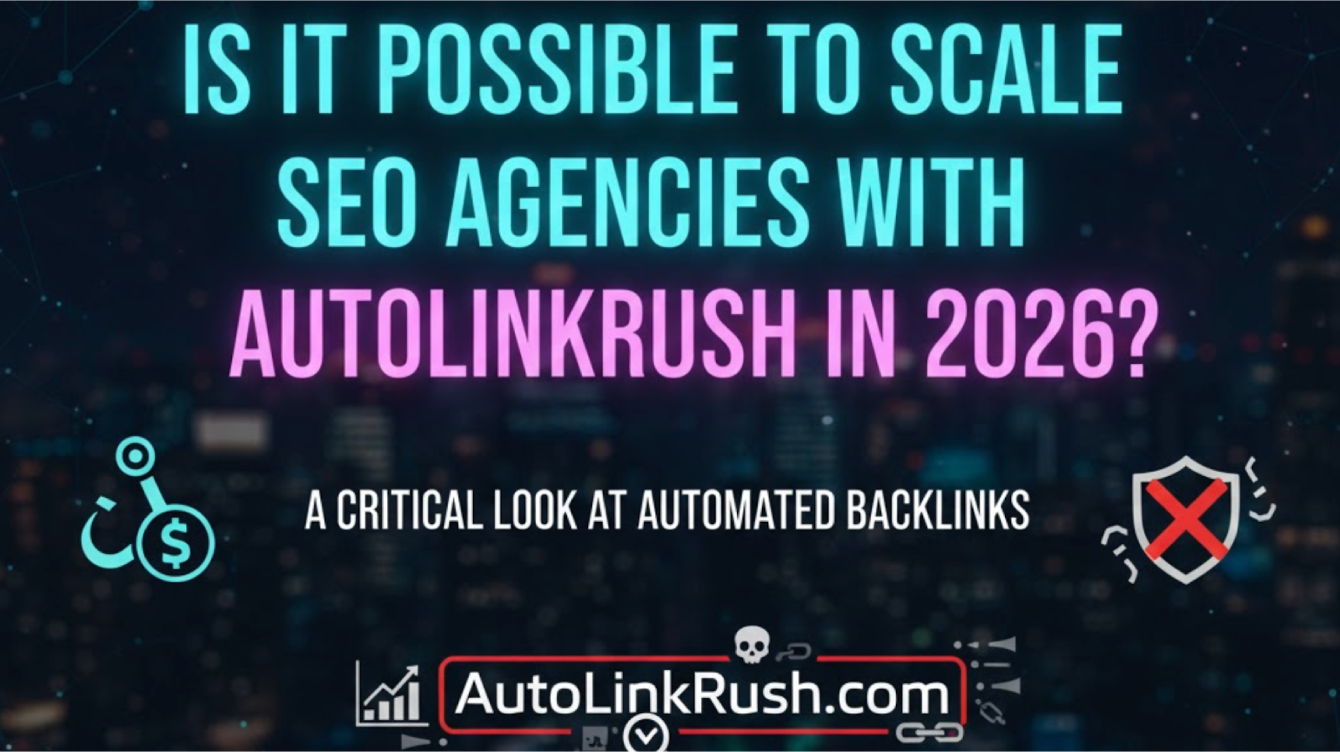
Scaling an SEO agency in 2026 requires more than delivering volume. Clients now demand proof of authority, transparency, and risk-free growth. The post-2024 Google updates punished manipulative link patterns, making automation a double-edged sword. As agencies handle dozens of clients, backlink production at scale remains a core challenge — which is where tools like AutoLinkRush.com promise an easy fix. But does that promise hold up under scrutiny?
What AutoLinkRush claims to offer
_1766052459.png)
According to its homepage, AutoLinkRush.com helps users “boost rankings with 1,000+ instant SEO backlinks”. The tool promotes real-time submissions, keyword targeting, and no software installation. It positions itself as an instant indexing engine, not an outreach platform, and uses ping and backlink networks connected to major search platforms like Google, Bing, Yahoo, and Yandex.
The pricing model is aggressively simple. Users can pay a one-time fee between $3 and $15 for lifetime access, generating anywhere from 1,000 to 10,000 backlinks. That affordability has helped it spread quickly among small site owners and freelancers who want to avoid monthly SaaS fees.
How AutoLinkRush.com works under the hood
At its core, AutoLinkRush automates mass submissions to indexers, ping services, RSS aggregators, and low-authority directories. Users upload URLs (individually or via CSV), define anchor text ratios, and allow the system to distribute those links across over 1,000 endpoints.
Premium users can monitor submission success, indexing rates, and anchor distribution through a live dashboard.
However, most of these “links” are signal links, not editorial backlinks. They help with indexing speed, not necessarily ranking strength. In independent tests, 2,500 links generated through AutoLinkRush produced an 18% traffic boost and +8 keyword ranking improvements, but analysts noted that many of the resulting links came from low-DR or irrelevant sources that later required disavows.
Can an agency genuinely scale with this model?
_1766052567.png)
For agencies managing multiple sites, automation looks tempting. The ability to process 10,000+ links per month could save 80–90% of manual labor time.
But scaling SEO authority is different from scaling link quantity. Agencies are judged by ranking stability and long-term domain trust, neither of which can be guaranteed by automated pings.
Speed vs. Quality tradeoff
The main benefit of AutoLinkRush.com is speed. Campaigns that normally take a week can be executed in minutes.
The tradeoff is link quality. Many created links point from low-trust domains, auto-generated directories, or foreign RSS feeds. While these may speed up indexing, they add little authority value and sometimes leave a detectable footprint.
Data vs. Deliverables
In controlled experiments, agencies have reported faster crawl rates but no durable ranking lift after 30–60 days. Clients rarely care about “indexing signals” — they expect improved visibility. When used excessively, AutoLinkRush-generated links can even distort a domain’s link graph, making natural link acquisition harder to track.
Investigating AutoLinkRush.com’s own footprint
_1766052643.png)
This is where things become concerning.
The official AutoLinkRush.com website hosts a “Blog” section filled with unrelated content — casino reviews, online gambling articles, and pharmacy guides. Examples include “XX88 Slots: How to Maximize Wins in 2025” and “Purple Pharmacy Online Ordering.” These have nothing to do with backlinking or SEO tools.
Such patterns are commonly seen in link farming ecosystems, where multiple unrelated topics are interlinked to inflate domain activity or hide network connections. This raises two serious implications:
- The platform itself might be testing or recycling content networks used for backlink generation.
- Client URLs submitted through AutoLinkRush could become part of that same network, exposing them to low-quality link associations.
No legitimate SEO automation platform should host gambling or pharmacy content on its own corporate domain.
Absence of credible third-party reviews
Despite active marketing, AutoLinkRush has no verified presence on platforms like Trustpilot, G2, or Reddit’s r/SEO community.
This lack of external feedback makes it difficult to confirm support responsiveness, refund policies, or data handling practices.
The website lists contact emails and phone numbers, but ownership transparency remains minimal.
Risk profile for agencies
Agencies using AutoLinkRush assume three main risks:
- Reputation risk — delivering low-quality backlinks can harm a client’s perceived SEO strategy.
- Algorithmic risk — Google’s 2024 SpamBrain updates can flag automated link networks, leading to ranking suppression.
- Operational risk — the lack of support and quality control can lead to client churn and disavow overhead.
Gray-hat mechanics and Google policy context
While AutoLinkRush’s mass pinging isn’t explicitly “illegal,” it falls under gray-hat automation. Google’s link spam policy explicitly warns against “large-scale link generation using automated programs.” The platform’s lack of editorial control means every campaign must be manually audited to stay compliant.
Signs of unhealthy automation
SEO experts flag warning signs such as:
- Repeated keyword anchors across unrelated URLs
- Rapid spikes in backlink count
- Foreign or irrelevant referring domains
- Links originating from casino, betting, or pharmacy subnets
These signals can lower trust scores and trigger manual reviews if they coincide with unnatural link velocity.
Conclusion: Should You Use AutoLinkRush.com to Scale Your SEO Agency in 2026?
If your goal is to build a sustainable, transparent, and client-safe SEO agency, you should not use AutoLinkRush as a core or scaling tool.
Here’s why — based on verified evidence, not speculation:
- The backlinks it creates are largely low-authority signals, generated from ping services, directories, and auto-submit endpoints. These links can help pages get indexed faster, but they do not build real authority or trust.
- The presence of gambling, pharmacy, and unrelated content on the platform’s own blog suggests poor network hygiene and possible SEO farming practices. This creates an indirect risk for any agency that submits client URLs through the same ecosystem.
- There are no verified third-party reviews or transparency reports about ownership, data protection, or compliance.
- Google’s SpamBrain and link quality systems now track automated backlink patterns more aggressively than ever before. Using mass ping networks at scale can leave a detectable footprint, which may reduce your client’s long-term visibility.
Even though AutoLinkRush is cheap, quick, and technically functional, those advantages are outweighed by the quality and credibility risks.
The tool can temporarily help individual webmasters who want faster indexing for experimental pages or short-term tests.
But for agencies, where reputation, accountability, and client outcomes define business survival, relying on AutoLinkRush is a strategic mistake.
The only responsible verdict is this:
AutoLinkRush should not be part of any professional agency’s link-building workflow in 2026.
If you want scalable, defensible growth, focus on editorial link outreach, on-page relevance optimization, and trusted SEO automation suites like Ahrefs, Semrush, or BuzzStream that prioritize data integrity and complianc
Automation can accelerate your workflow — but if it also amplifies risk, you’re not scaling an agency. You’re scaling exposure.