
What is apkek.org?
apkek.org presents itself as a website that combines blog-style articles with APK download links. On the surface, it resembles an “alternative app store,” but structurally it behaves more like a content-driven site that embeds download links inside informational posts.
There are no user accounts, no app verification process, and no developer dashboards. Everything is delivered through static articles optimized to rank on search engines. This positioning matters, because it sets the tone for how much responsibility the platform takes for the files it distributes.
Once you understand that apkek.org is not a managed app ecosystem, the next logical question is what it claims to offer versus what it can realistically support.
What apkek.org Claims to Offer vs What It Delivers in Reality
apkek.org frequently uses reassuring language such as:
“100% safe and secure”
“Virus-free APKs”
“Latest versions available”
“Premium features unlocked”
In reality, the site delivers modified APK files and informational blog posts, not official app releases. There is no evidence of direct partnerships with app developers and no indication that files are distributed with developer consent.
This gap between claims and delivery doesn’t automatically make the site malicious—but it does mean users are expected to trust assurances that cannot be independently verified.
That trust gap becomes more significant when we look at how the site actually categorizes and publishes content.
Is apkek.org a Blog or an App Store?
apkek.org is not an app store in the technical sense.
A true app store:
- verifies developer identities
- preserves cryptographic signatures
- controls update channels
- enforces security policies
apkek.org does none of these. Instead, it operates as a blog that hosts APK links, using articles as containers for downloads.
This hybrid model creates confusion. Users may assume store-like safety standards, while the site functions under blog-level responsibility. Understanding this distinction helps explain why risks are shifted entirely onto the user.
That structure also influences the type of content that ranks on the site.
Content Categories and Ranking Articles
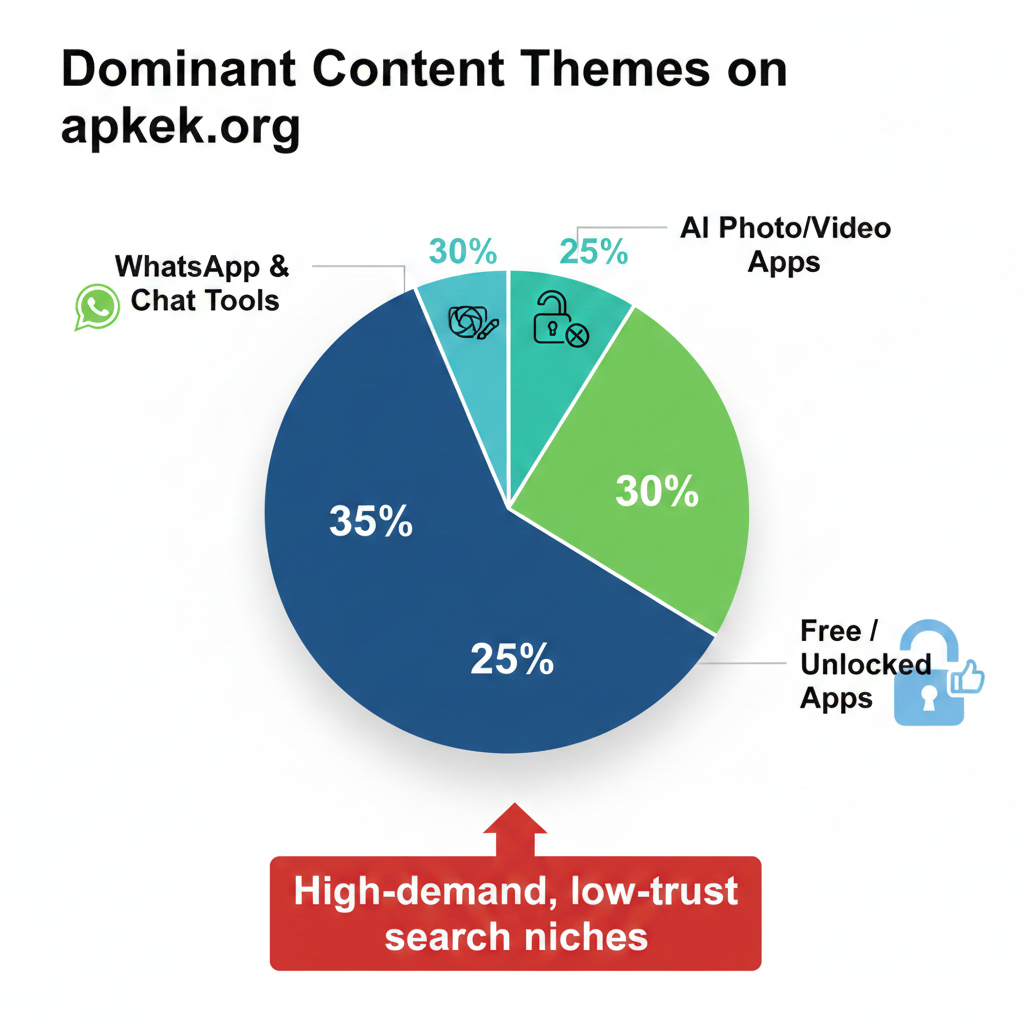
The most visible content on apkek.org focuses on:
- WhatsApp tricks and features
- Instagram or chat-related tools
- AI photo and video apps
- “Free” or “unlocked” premium applications
These are high-demand, low-trust niches where users often prioritize access over safety. The category spread is broad, suggesting a search-traffic strategy, not a focused editorial mission.
When a site covers many unrelated topics under one roof, it usually signals that reach is prioritized over expertise, which directly affects content reliability.
That brings us to the most critical technical issue: the nature of the APKs themselves.
Mod APKs Explained: Why File Modification Changes Everything
Most downloadable files on apkek.org are Mod APKs, meaning the original app code has been altered after release.
Common modifications include:
- unlocking paid features
- removing ads
- bypassing restrictions
The problem isn’t just legality, it’s integrity. Once an APK is modified:
- the original developer no longer controls the code
- new behavior can be inserted invisibly
- users lose any guarantee of safety
Even if the app works as expected, it is no longer trustworthy by design. This is why safety claims on such platforms should be treated cautiously.
And those risks don’t always appear immediately.
Safety Claims vs Technical Reality
_1766751681.png)
apkek.org often claims that its files are safe or virus-free. Technically, many modded apps do pass basic antivirus scans.
However, modern threats don’t behave like obvious malware. Instead, they rely on:
- delayed activation
- background tracking
- permission abuse
This is sometimes referred to as “sleeper behavior,” where harmful actions occur long after installation. Antivirus tools are not designed to detect intent, only known signatures.
That’s why a file can be “clean” and still compromise privacy or security over time.
The issue becomes more serious when we look at app authenticity.
App Authenticity and Signature Mismatch Risks
Official Android apps are cryptographically signed by their developers. This signature allows the operating system to verify that the app:
- hasn’t been altered
- comes from a trusted source
- can be safely updated
APKs from apkek.org break this trust chain. As a result:
- Android cannot verify authenticity
- Play Store updates fail
- Users are locked into outdated or altered builds
This increases exposure to exploits and makes long-term maintenance impossible. Once installed, the user has no reliable way to know what the app is doing internally.
Permissions play a major role here as well.
Advertising, Redirects, and Notification Spam Risks
The download experience on apkek.org often involves:
- multiple redirect pages
- fake or duplicated download buttons
- notification permission prompts
A single misclick can enable persistent notification spam or browser-level tracking that remains even after uninstalling the app.
Many users blame their device for these issues, not realizing the trigger occurred during the download process. This indirect risk is one of the most common side effects reported with similar platforms.
At this point, transparency becomes critical, but that’s where apkek.org is weakest.
Transparency, Ownership, and Overall Trustworthiness
apkek.org provides little to no verifiable information about:
- who owns or operates the site
- where it is based
- What standards govern content or files
There is typically no detailed About page, no named team, and no accountability framework. Domain privacy is used to hide ownership details, which is common for sites operating in legal gray areas.
Final Conclusion
After going through apkek.org end-to-end, not just reading articles, but paying attention to how downloads are presented, how claims are framed, and what information is missing, my view is fairly settled.
I don’t see apkek.org as a deceptive scam site designed to immediately harm users. Pages load normally, content is readable, and many apps do install and run. That’s why it continues to attract traffic.
At the same time, I also don’t see a platform that deserves trust.
What apkek.org really represents is a high-risk convenience trade-off. It prioritizes access over integrity, reach over accountability, and short-term usability over long-term security. The site asks users to trust claims like “safe” and “virus-free” without providing any verifiable framework to support those claims, no developer partnerships, no file verification process, no editorial or technical accountability.
Personally, I would never install an app from apkek.org on:
- a primary phone
- a device used for banking or payments
- a phone linked to personal or work accounts
Even if nothing goes wrong immediately, the lack of transparency and broken trust chains mean problems can surface later, quietly and without warning.
In my view, apkek.org isn’t dangerous because it looks shady.
It’s risky because it looks normal while operating outside every safeguard Android is built around.
My Rating
This is not a popularity score or a star-rating meant to encourage use.
It’s a breakdown of risk exposure based on how the platform actually operates.
User Safety (Technical): ⭐⭐☆☆☆ (2/5)
Apps may install and run, but integrity cannot be verified and risks persist over time.
Data Privacy: ⭐☆☆☆☆ (1/5)
High exposure due to modded apps, permission abuse, and ad-network behavior.
Transparency & Accountability: ⭐☆☆☆☆ (1/5)
No ownership disclosure, no responsible entity, no clear standards.
Legitimacy as an App Source: ⭐⭐☆☆☆ (2/5)
Operationally real, but not legitimate in the sense of authorized distribution.
Overall Classification:
Low-Trust, High-Risk APK Distribution Platform
That doesn’t make apkek.org “evil”, but it does make it unsuitable for anyone who values device security, privacy, or official support.
And in practice, that distinction matters far more than whether an app happens to work today.